

When wholesale buyers evaluate eyewear suppliers, material selection is often treated as a product decision first and a pricing decision second. In practice, the order matters in reverse: the material you choose shapes your entire cost structure before it shapes your product catalog.
Understanding how frame materials affect wholesale pricing helps you make better sourcing decisions, negotiate more effectively with manufacturers, and build a product line where the economics support your business goals.
The Four Variables That Connect Material to Price
1. Raw material cost. Some materials are simply more expensive to produce. Titanium requires specialized fabrication equipment and skilled operators. Acetate sheets need to be sourced from specialty manufacturers like Mazzucchelli in Italy or Eastman in the US. TR90 granules are a commodity. This cost layer is visible and easy to compare — but it’s not the whole story.
2. Processing complexity. A pure titanium frame requires multiple operations that don’t appear in the material cost: precision milling, welding, heat treatment, and surface polishing. An acetate frame requires hand-finishing at several stages. TR90 frames are injection-molded, which is faster and less labor-intensive. Processing complexity explains why a titanium frame and a TR90 frame made from the same shape mold can have significantly different wholesale prices.
3. Yield and reject rates. Titanium fabrication has a learning curve — reject rates are higher when factories are working with a new alloy specification or a design that requires tighter tolerances. Acetate frames can develop hairline cracks during machining that aren’t visible until final QC. The reject rate affects what you pay per good unit, not just per unit started.
4. Tooling and setup. For custom OEM orders, tooling costs are amortized across the order quantity. A complex titanium mold with multiple precision-machined components costs more to produce than a simple TR90 injection mold. For larger orders, this amortized tooling cost per unit becomes less significant; for smaller orders, it can dominate the unit price calculation.
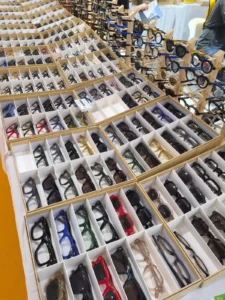
Material Cost Comparison: What the Numbers Actually Look Like
The following ranges represent approximate cost differentials at the manufacturing level for typical wholesale orders of 1,000 pieces per style. Specific pricing varies by design complexity, order quantity, and supplier.
TR90 (nylon) sits at the lowest end of the cost range. Material cost is low, injection molding is fast, and processing is consistent. For buyers targeting the mass-market channel — pharmacy, value retail, Amazon — TR90 delivers a cost structure that supports aggressive retail pricing. Weight is competitive (12-16g per frame), and modern TR90 styles have moved well beyond purely sport-oriented designs.
Acetate (standard) moves up from TR90. Hand-finishing labor adds cost, and material quality varies significantly by source. Mazzucchelli acetate costs more than commodity acetate but produces a noticeably deeper color and better surface finish. At the wholesale level, a well-made acetate frame in a standard shape typically costs 30-50% more than a comparable TR90 frame. This cost difference is recovered in the retail experience: acetate frames retail at a higher price point and carry better perceived quality.
Acetate (ISCC-certified eco) costs more than standard acetate but the premium is narrower than most buyers expect — typically 5-15% above equivalent standard acetate. For buyers serving European retail chains with sustainability requirements, the documentation advantage outweighs the modest cost premium.
Aluminum-magnesium alloy occupies a middle-to-upper position. The material itself is relatively affordable, but machining requires specific equipment and the finishing process (brushing, anodizing) adds steps. Expect pricing roughly comparable to mid-range acetate or slightly above.
Beta-titanium moves significantly higher. The alloy is more expensive, the fabrication requires specialized welding and finishing, and the tolerance requirements are tighter. For a complete beta-titanium optical frame with quality finishing, wholesale pricing typically runs 60-100% above equivalent acetate. The market that supports this price point is premium optical: independent opticians, specialty chains, brands with retail prices of $150-400+.
Pure titanium is at the top of the standard materials range. Pure titanium frames for wholesale typically command pricing comparable to or above beta-titanium, depending on the design and finishing level. The weight advantage (10-12g for a complete frame) and hypoallergenic properties support premium retail positioning.

How to Use This Framework When Sourcing
Start by understanding your target retail price and work backwards. If you’re selling to a mass-market retailer at a $25-40 retail price point, TR90 or standard acetate is the realistic material range. If you’re selling through independent optical shops at $150-350, titanium or high-end acetate is where your product line needs to sit to support the brand experience customers expect at that price.
The mistake many new buyers make is trying to use premium materials at mass-market pricing. An acetate frame sourced at a price that seems competitive will not feel competitive if the finishing quality doesn’t match the material. Material and execution quality need to be aligned.
When you visit a supplier, ask specifically about their material sourcing. Where do they get their acetate? Do they work with Mazzucchelli or Eastman? What alloy specification do they use for their beta-titanium? Suppliers who can answer these questions with precision are the ones who understand the material-level variables that affect both cost and quality.
Material Choice and Your Order Quantity
Material affects not just unit price but the order quantity economics. TR90 injection molding has a relatively low tooling cost amortized per unit. Acetate hand-finishing requires more labor time per frame regardless of quantity. Titanium fabrication has significant fixed setup costs. This means the per-unit price gap between materials narrows at higher volumes and widens at lower volumes.
For trial orders under 500 pieces, material selection has a larger impact on unit pricing than you might expect from looking at catalog prices. For orders of 3,000+ pieces per style, the material itself becomes the primary price driver and the gap between materials is more predictable.
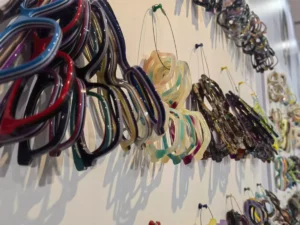
Our Material Sourcing and What We Offer
Our factory works across the full material range: TR90, acetate (standard and ISCC-certified eco), aluminum-magnesium alloy, beta-titanium, and pure titanium. We source acetate from Eastman for our eco line and work with verified titanium alloy specifications that we can document on request.
For buyers who are still defining their material strategy, the factory visit is where this conversation becomes concrete. We can show you actual cost differentials with physical samples in hand, discuss the retail positioning implications of each material, and help you find the material range that fits your target market.
- WhatsApp: +86 152 5809 0639 (Mimi)
- Email: mimi@wenzhouframe.com
Wenzhouframe — Established 2015. Wenzhou, China. Optical frames, sunglasses, reading glasses, and blue light glasses across TR90, acetate, titanium, and specialty alloys. OEM/ODM with NDA. Flexible MOQ. Factory-direct pricing.
FAQ
What is the most cost-effective material for high-volume wholesale orders?
TR90 is generally the most cost-effective for volume orders targeting the mass market. For orders of 3,000+ pieces, the per-unit cost difference between materials is more predictable and the pricing advantage of TR90 becomes most pronounced.
Is eco-acetate worth the premium for the European market?
For buyers serving EU retail chains with sustainability requirements, yes — the ISCC documentation is increasingly a procurement requirement. For other markets, the premium may not be recoverable in retail pricing, and standard acetate is the practical choice.
Can I order multiple materials in one order to test the market?
Yes. This is a common approach for buyers who are still validating their product line direction. Discuss your specific quantities and material interests with us and we’ll structure a sampling and initial order plan that makes sense for your situation.

6.17_11.webp)