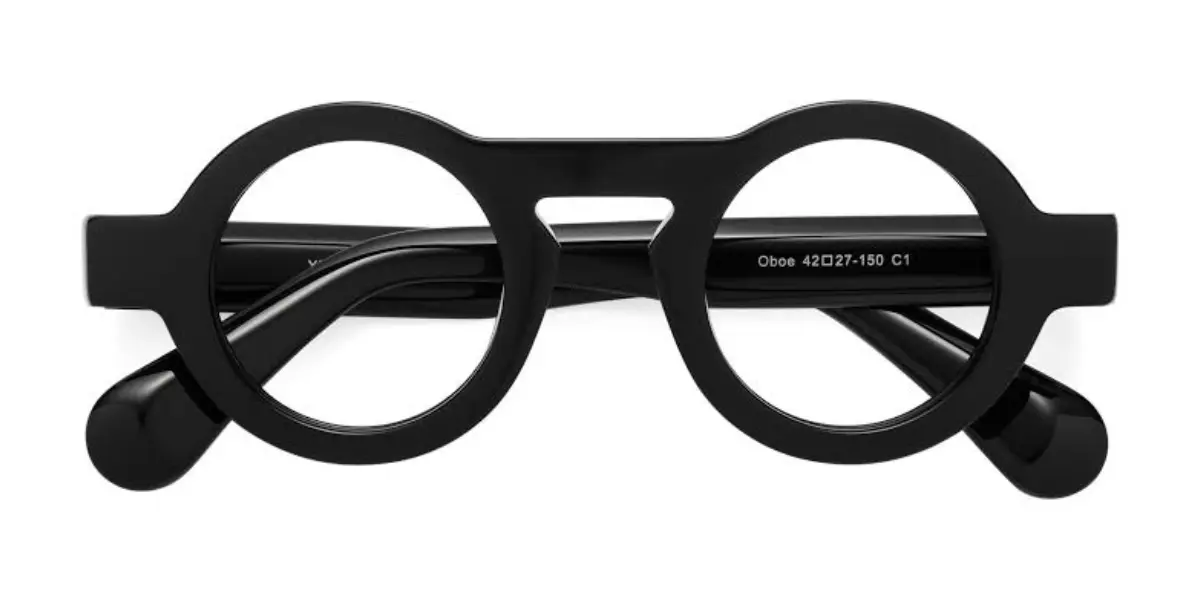
Walk into any luxury eyewear boutique and the price tags tell a story: $350 for Tom Ford. $800 for Cartier. $1,500 for Jacques Marie Mage. $2,000+ for Chrome Hearts.
But what exactly are you paying for at each tier? And more importantly for buyers sourcing frames for their own brands — what does a factory need to actually produce eyewear that commands those prices?
This guide breaks down the materials, processes, equipment, certifications, and quality systems that separate a $3 commodity frame from a $30 premium frame from a $300 luxury frame. Because the gap isn’t branding alone. It’s measurable, verifiable, and testable — if you know what to look for.

1. The Premium Eyewater Landscape: Brands, Prices, and Materials
Before discussing manufacturing, it helps to understand what the market considers “premium” — and what those brands actually put into their frames.
Tier 1: Ultra-Luxury ($600–$2,500+)
| Brand | Retail Price | Primary Materials | What Justifies the Price |
|---|---|---|---|
| Cartier | $800–$2,500+ | 18–24K gold-plated metals, precious aesthetics | 175-year jewelry heritage; gold plating on every contact point; re-gilding service for wear |
| Jacques Marie Mage | $700–$1,500+ | Custom Mazzucchelli crystal acetate | Numbered limited editions; Japan Fukui hand-finishing; each frame is a collectible |
| Chrome Hearts | $600–$2,000+ | Sterling silver hardware, exotic leather temples | Hand-fabricated silver hardware in own LA workshop; verifiable .925 silver |
Tier 2: Investment Luxury ($350–$1,800)
| Brand | Retail Price | Primary Materials | What Justifies the Price |
|---|---|---|---|
| Dita | $500–$1,800 | Grade 5 aerospace titanium, 7-barrel Japanese hinges | Titanium throughout; Japan-made hinge structures; multi-step hand-finishing in Fukui |
| Oliver Peoples | $350–$550 | Proprietary Mazzucchelli acetate | Most developed proprietary color program in eyewear; decades of sustained production proving design permanence |
| Tom Ford | $350–$600 | Premium acetate, metal with brow detailing | T-bar hardware as structural identity; bold visual impact designed for deliberate confidence |
| Gucci | $320–$650 | Italian acetate, rich tortoise and warm neutrals | Consistent Italian manufacturing; equestrian heritage details; broadest design range in accessible luxury |
Tier 3: Accessible Premium ($180–$500)
| Brand | Retail Price | Primary Materials | What Justifies the Price |
|---|---|---|---|
| Ray-Ban | $180–$350 | Standard acetate, metal, G-15 glass lenses | 80 years of cultural history; brand value is cultural, not craft |
| Garrett Leight | $300–$500 | Premium Italian acetate, bio-acetate options | Proprietary colorways developed for West Coast light; material quality exceeding price point |
The pattern is clear: as prices climb, materials shift from standard to proprietary, production shifts from automated to hand-finished, and hardware shifts from generic to purpose-engineered.
2. The Six Processes That Define Premium Manufacturing
A mass-produced frame might pass through 30–50 steps. A genuinely premium frame goes through 80–200+ individual operations, depending on material and complexity. Here are the six stages where premium and commodity diverge most sharply.
Stage 1: Material Selection and Preparation
What commodity factories do: Buy acetate sheet from whoever is cheapest. Accept mixed batches. Store it in uncontrolled conditions.
What premium factories do:
- Source Mazzucchelli 1849 acetate from Italy — the industry benchmark since 1849 — or Eastman Acetate Renew (ISCC-certified recycled) for eco-premium positioning
- Inspect every sheet for thickness consistency, color uniformity, and internal bubbles before acceptance
- Acclimatize sheets in climate-controlled storage (temperature + humidity) for minimum 48 hours before cutting — because acetate expands and contracts with moisture
- For titanium: specify Grade 1 (pure, softest) or Grade 5 (Ti-6Al-4V, aerospace-grade) with mill certificates verifying composition
- For metal alloys: use lead-free nickel silver or stainless steel — never mystery alloys
Why it matters: A $2 per sheet difference in acetate creates a $20 difference at retail because color depth, pattern consistency, and polishability are all determined before the first cut.
Stage 2: CNC Cutting and Shaping
What commodity factories do: Use older 3-axis CNC machines with worn tooling. Tolerances of ±0.5mm are “good enough.” Change cutting tools infrequently to save cost.
What premium factories do:
- Run 4-axis or 5-axis CNC machines with fresh cutting tools replaced every 200–400 frames to maintain edge quality
- Maintain tolerances of ±0.1mm or tighter on critical dimensions (lens groove, hinge pocket, bridge width)
- Use dedicated fixturing (CNC beds designed for eyewear) that holds acetate or titanium blanks without flex
- Operate CNC in temperature-controlled environments — thermal expansion affects precision
Equipment investment reality: A single 4-axis CNC for eyewear costs $5,000–$15,000. A premium factory running 4+ machines has $60,000+ invested just in cutting. This is before we talk about tooling wear, fixtures, and programming.
Stage 3: Hand-Shaping, Assembly, and Hinge Integration
What commodity factories do: Press hinges into acetate with basic heat guns. Tolerances are loose — hinges may sit slightly angled. Wire core insertion is automated with minimal temperature control.
What premium factories do:
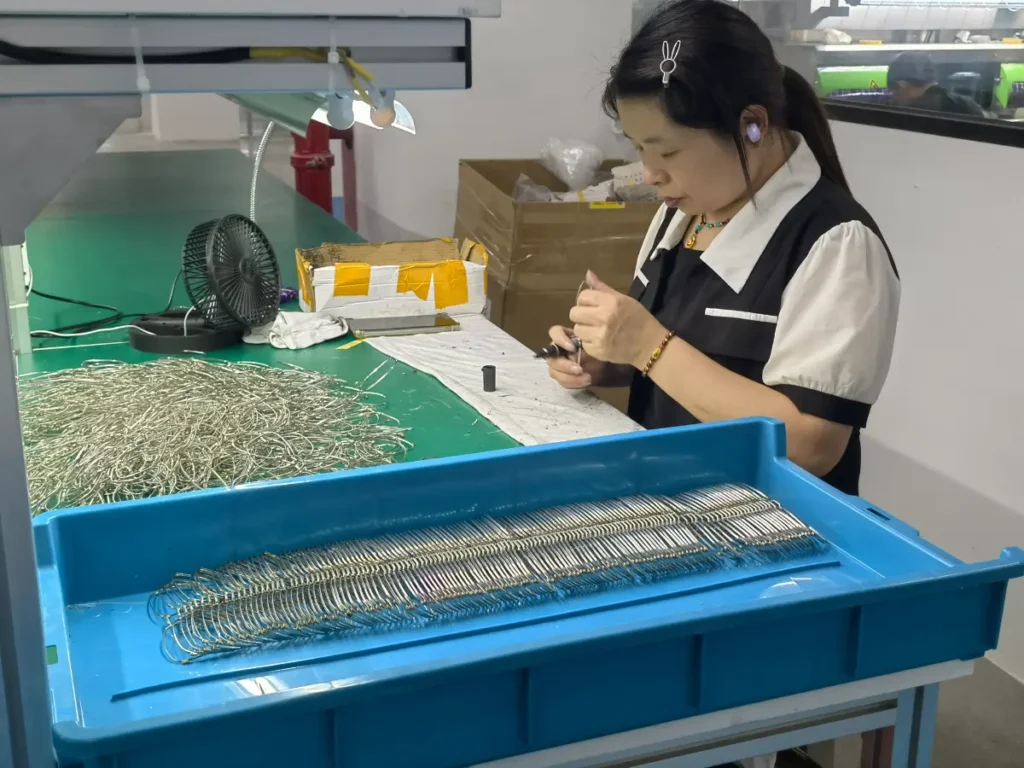
- Use precision wire shooters (the advanced ones cost $5,000–$6,000 each) with controlled temperature heating units ($3,000+) to embed metal cores into acetate temples at exact depth and alignment
- Hand-shape every frame after CNC to remove tool marks using a graded abrasive sequence: P400 → P600 → P1000 → P2000
- Create precise V-bevel grooves for lens seating using dedicated grooving tools
- Hand-bend and form nose pads for ergonomic fit
- Install OBE (German) or KANGHUA (Chinese premium) spring hinges rather than commodity-grade alternatives
Read more about hinge quality tiers in our complete hinge sourcing guide.
Stage 4: Barrel Tumbling — The Process That Cannot Be Rushed
This is where premium eyewear earns its finish. And it is the single most commonly cut corner in commodity production.
What commodity factories do: Tumble frames for 2–4 hours in basic media. Result: acceptable shine at arm’s length, visible micro-scratches under magnification.
What premium factories do:
- Stage 1: Tumble with hardwood pegs and natural volcanic pumice for 8–12 hours — smoothing the surface and removing visible scratches
- Stage 2: Tumble with hardwood cubes and fine polishing paste for another 8–12 hours — building deep gloss
- Optional Stage 3: Additional tumbling for ultra-high-gloss finishes
- Total time: 16–36+ hours per batch
The hard truth: Barrel tumbling cannot be accelerated without degrading the finish. A factory that claims to produce premium acetate frames in 48 hours total production time is either lying about the finish or lying about the timeline.
Measurable difference: Premium acetate achieves surface gloss of 70–95 GU at 60° and surface roughness below Ra 0.8 µm. Commodity acetate typically lands at 40–60 GU with Ra above 1.2 µm.
Stage 5: Hand Polishing and Final Finishing
After tumbling, premium frames receive manual polishing that machines alone cannot deliver:
- Felt wheel and muslin buff polishing with compound matched to substrate (rouge, Tripoli, or silicon-based)
- Hand-detailing of areas machines miss: inside the lens rim, around hinge pockets, along temple tips
- For metal frames: multi-step polishing from coarse to mirror before plating, with minimal post-plating polishing to preserve coating integrity
- Intermittent polishing (not continuous) to prevent heat damage — if the frame feels warm to touch, polishing must pause
For TR90 frames specifically, low-pressure rotary polishing with non-abrasive compounds is used because excessive heat melts the nylon substrate.
Stage 6: Quality Control — The True Differentiator
This is where the gap between commodity and premium becomes binary. Not gradual — binary.
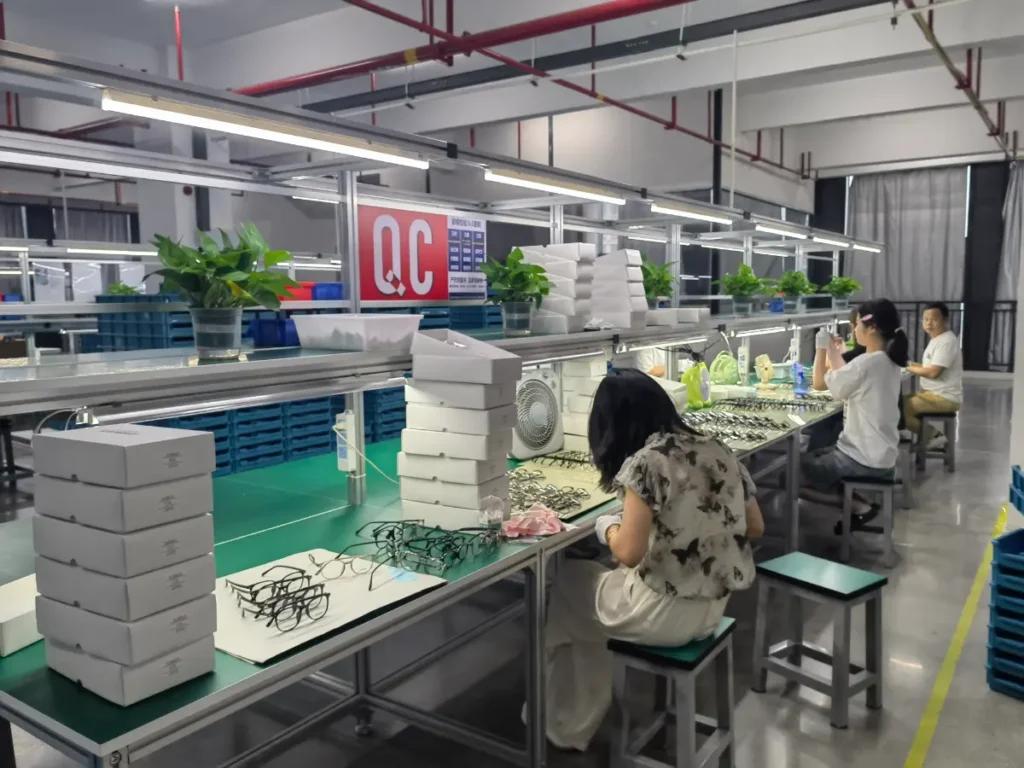
Commodity QC: Visual inspection at final stage. Maybe check a few dimensions. Ship it.
Premium QC — what a proper factory must have:
Incoming Material Inspection
- Acetate sheet thickness verification (micrometer)
- Color consistency check against master standard (light box)
- Metal alloy composition verification (mill certificates + spot checks)
- Titanium grade confirmation for every batch
In-Process Quality Checks
- CNC output dimension check (A-box, B-box, DBL, temple length) after every setup change
- Hinge pocket alignment verification before assembly
- Wire core depth and straightness check after insertion
- Frame symmetry check after forming
Pre-Polishing Inspection
- Surface defect mapping — any scratch, tool mark, or imperfection identified before tumbling (finding defects after polishing means rework or scrap)
- Dimensional verification at ±0.2mm tolerance on all critical measurements
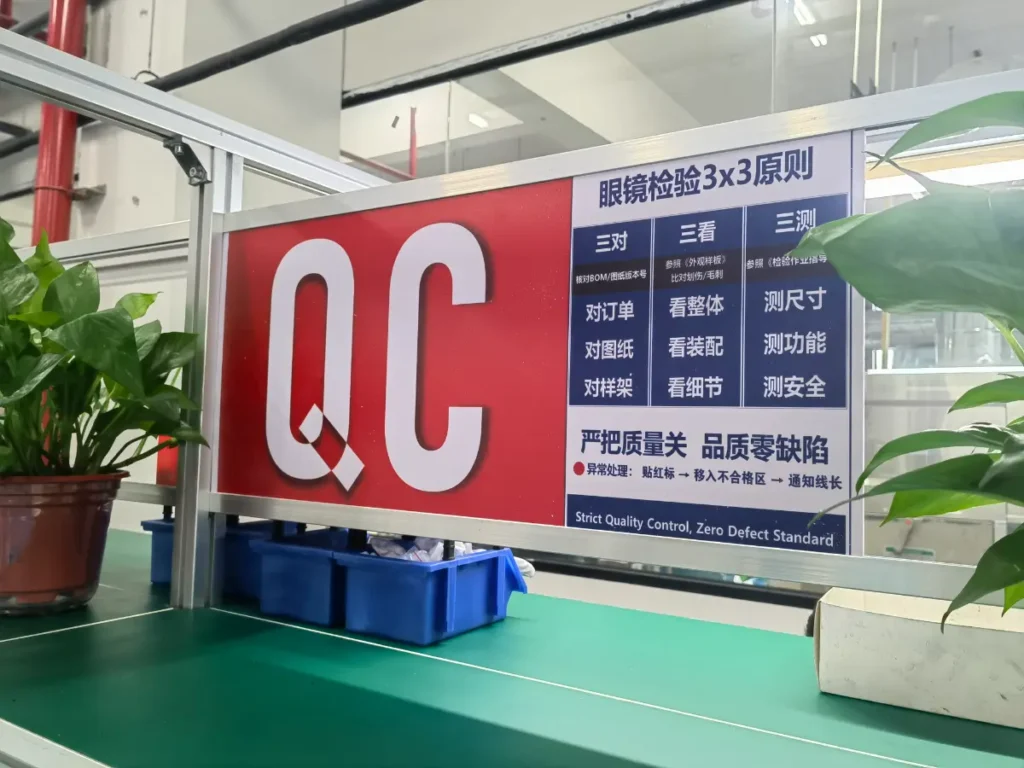
Final Inspection (100% for Premium, Not Sampling)
- Gloss meter reading (60° angle) — must hit target GU range for material type
- Surface roughness check (Ra µm) using handheld roughness tester
- Hinge torque test — opens and closes with correct resistance, no wobble
- Alignment check — temples parallel, frame sits level on flat surface
- Visual inspection under 10x magnification and calibrated light box
- Logo/engraving quality — crisp, complete, correctly positioned
AQL Standards: What Level Should You Require?
For premium frames, the industry standard is:
- AQL Level: General Inspection Level II (per ISO 2859-1)
- Critical defects: AQL 0 — zero tolerance (nickel release failure, structural weakness, wrong prescription)
- Major defects: AQL 1.0 (visible scratches, misalignment, color mismatch)
- Minor defects: AQL 2.5 (micro-scratches visible only under 10x, slight gloss variation)
For commodity/standard frames, most factories use AQL 2.5 across all defect categories. The difference between AQL 1.0 and AQL 2.5 on a 1,000-piece order could mean accepting 14 defective frames versus 35. If those frames retail at $200+, you just ate $4,200 in returns.
3. Factory Equipment Checklist: What to Verify
When evaluating a factory’s ability to produce premium frames, don’t ask “Can you make high quality?” — every factory says yes. Instead, verify the presence of specific equipment. These are non-negotiable for premium production.
Cutting and Shaping Equipment
- ✅ 4-axis or 5-axis CNC machines (minimum 2 for any serious premium production)
- ✅ CNC beds/fixtures designed for eyewear blanks (not generic vises)
- ✅ Drilling station for pre-CNC hole placement
- ✅ Shaping station with grooving tools for V-bevel lens seats
- ✅ Rounding tools (4mm and 6mm) for temple tip finishing
Assembly Equipment
- ✅ Controlled-temperature wire heaters (not heat guns) for core insertion
- ✅ Wire shooting machines with depth control
- ✅ Precision hinge installation tools
- ✅ Forming tools and jigs for 3D frame shaping
Finishing Equipment
- ✅ Barrel tumbling machines with hardwood media capacity
- ✅ Polishing stations with variable-speed spindles (felt + muslin wheels)
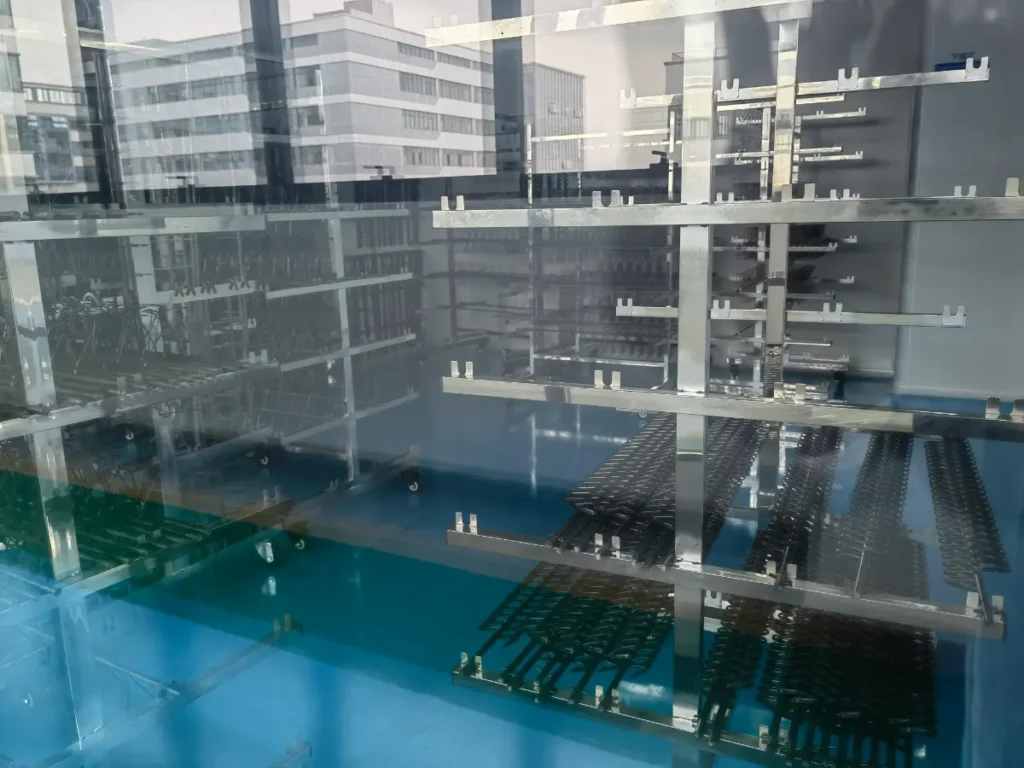
- ✅ Ultrasonic cleaning for post-polish residue removal
Quality Control Instruments
- ✅ Gloss meter (60° measurement)
- ✅ Handheld roughness tester (Ra µm)
- ✅ Calibrated digital calipers
- ✅ Hinge torque tester
- ✅ Calibrated light box for visual inspection
- ✅ Go/no-go gauges for temple and rim dimensions
- ✅ Optical comparator for premium lines
- ✅ 10x magnifier for surface inspection
Plating Line (For Metal Frames)
- ✅ Multi-tank electroplating line with nickel-free options
- ✅ Salt spray test chamber for corrosion testing
- ✅ Cross-hatch adhesion tester for coating quality
A factory missing any of these items is not equipped for premium production — regardless of what their marketing materials claim.
4. Certifications and Testing: The Paper Trail That Proves Quality
Certifications are not decorative. They are the difference between a frame that clears customs and one that gets detained. Here is what matters, by market.
Factory Certifications (Your Factory Should Have These)
| Certification | What It Proves | Required For |
|---|---|---|
| ISO 9001 | Quality management system with documented processes, traceability, and continuous improvement | Baseline for any B2B buyer worth having |
| ISO 14001 | Environmental management system | EU market; increasingly expected globally |
| SEDEX 4-Pillar | Ethical supply chain: labor, health & safety, environment, business ethics | UK and EU retailers; large chains |
| GMP | Good Manufacturing Practice with traceable batch records | Medical device markets |
| BSCI | Business Social Compliance Initiative | European retailers and importers |
Product Compliance (Every Batch Must Meet These)
| Standard / Test | What It Covers | Market |
|---|---|---|
| CE Marking (EN 1836 / EN ISO 12312-1) | Sunglasses safety: UV filtration, impact resistance, light transmittance categories 0–4 | EU (mandatory) |
| FDA 21 CFR Part 801 | Sunglasses and medical device registration; drop ball test for impact resistance | USA (mandatory) |
| ISO 12870 | Frame requirements: mechanical strength, corrosion resistance, artificial aging | International baseline |
| ANSI Z80.3 | Non-prescription sunglasses and fashion eyewear requirements | USA |
| EN 1811 (Nickel Release) | Tests nickel migration from metal parts in prolonged skin contact; limit: 0.5 µg/cm²/week | EU under REACH (mandatory) |
| RoHS | Restricts lead, mercury, cadmium, and other hazardous substances | EU (mandatory); increasingly global |
| CPSIA | Lead and phthalate limits in children’s products | USA (mandatory for kids’ eyewear) |
Product Testing (Every Batch or Per Customer Request)
| Test | Standard | What It Verifies | Typical Frequency |
|---|---|---|---|
| Drop Ball Test | FDA / EN 1836 | Lens impact resistance — a 5/8-inch steel ball dropped from 50 inches must not crack the lens | Every batch |
| UV400 Test | EN 1836 / ISO 12312-1 | Blocks 99–100% of UVA and UVB radiation up to 400nm | Every sunglasses batch |
| Nickel Release Test | EN 1811 | Confirms metal parts don’t exceed 0.5 µg/cm²/week nickel migration | Every metal frame batch |
| Salt Spray Test | ISO 12870 | Metal corrosion resistance under simulated sweat/salt exposure | Every metal frame batch |
| Artificial Sweat Test | ISO 12870 | 24–48 hour immersion in artificial sweat solution; no corrosion or coating failure | Every metal frame batch |
| Cross-Hatch (Adhesion) Test | ISO 2409 | Plating/coating adhesion quality — tape pull after cross-hatch cut | Every plated frame batch |
| Hinge Cycle Test | Internal / customer spec | Minimum 10,000 open-close cycles without failure | Per new design or supplier change |
| Color Fastness | ISO 105-B02 | Acetate color stability under artificial light exposure | Per new colorway |
Third-party testing labs: Results are only credible when verified by accredited labs like SGS, TÜV, Intertek, Bureau Veritas, or QIMA.
5. The Factory Process Flow: Step by Step
Here is the complete production flow for a premium acetate frame, from raw material to packed product. Each step represents an inspection opportunity — and a potential point of failure if skipped.
- Incoming Material QC — Acetate sheet inspection, metal alloy verification, titanium grade certification
- Acclimatization — 48+ hours in climate-controlled storage
- Pre-Drilling — Precision hole placement for CNC fixturing
- CNC Milling — Frame front and temples cut to ±0.1mm tolerance
- Wire Core Insertion — Heated and shot into acetate temples with depth control
- Hand-Shaping — Removal of CNC marks; graded abrasive sequence P400→P2000
- V-Groove Cutting — Lens seating channel with dedicated grooving tool
- Forming — Heating and bending flat acetate into 3D frame geometry
- Nose Pad Shaping — Hand-bent for ergonomic fit
- Hinge Installation — Pressed and aligned with precision tools
- Pre-Polish QC — Surface mapping, dimensional verification before tumble
- Barrel Tumbling Stage 1 — 8–12 hours with pumice and hardwood pegs
- Barrel Tumbling Stage 2 — 8–12 hours with polishing paste and hardwood cubes
- Hand Polishing — Felt/muslin wheel with matched compounds; intermittent to prevent heat damage
- Ultrasonic Cleaning — Residue removal
- Lens Fitting — Prescription or sun lenses cut and seated
- 100% Final Inspection — Gloss meter, roughness tester, torque tester, 10x visual, light box, alignment check
- Packaging — Custom cases, microfiber cloths, tags, compliance labeling
Total elapsed time: 7–14 days minimum for premium acetate. Commodity frames can be turned in 3–5 days because they skip the tumbling time, reduce hand-finishing, and inspect by sampling instead of 100%.
6. What B2B Buyers Actually Care About (And How to Address It)
Having worked with hundreds of eyewear buyers across different markets, here are the real concerns that come up — and the responses that actually work.
“How do I know your quality is actually premium?”
Don’t say “best quality.” Instead, offer specifics:
- “We use Mazzucchelli 1849 acetate — the same supplier Oliver Peoples and JMM specify. We can provide the lot number for your order.”
- “Our CNC tolerances are ±0.1mm. We’ll include dimensional reports for your first production run.”
- “Every frame in your order will be 100% inspected — not sampled. Gloss meter and roughness readings are recorded per batch.”
“What about compliance? I can’t afford a recall.”
This is where most commodity factories fall silent. The correct answer:
- “Our factory is ISO 9001 certified. We maintain batch traceability from raw material to finished product.”
- “We test every batch for nickel release (EN 1811), salt spray corrosion, and UV400 for sunglasses.”
- “We can arrange third-party testing through SGS, TÜV, or Intertek at your request. Test reports ship with the goods.”
- “We provide CE documentation and FDA registration support for every shipment.”
“What if I get the order and the quality isn’t what I expected?”
The honest, trust-building answer:
- “We recommend starting with sample confirmation. We’ll produce samples to your exact specification. You approve the sample — that becomes the production standard.”
- “We provide pre-shipment inspection photos and video for every order. You see what you’re getting before it ships.”
- “Our AQL for premium orders is Critical 0 / Major 1.0 / Minor 2.5. If a batch exceeds those limits, we rework or replace at our cost.”
“I’ve been burned by factories before. How are you different?”
Acknowledge the reality — don’t pretend it doesn’t happen:
- “The eyewear industry has a transparency problem. A lot of what’s sold as ‘premium’ online is commodity production with premium pricing. Here’s what to look for when evaluating any factory…”
- “Ask for their QC instrument list. If they don’t own a gloss meter and a roughness tester, they can’t verify premium finish — they’re judging by eye.”
- “Ask for their AQL standard in writing. If they can’t tell you their defect tolerance levels, they don’t have a real quality system.”
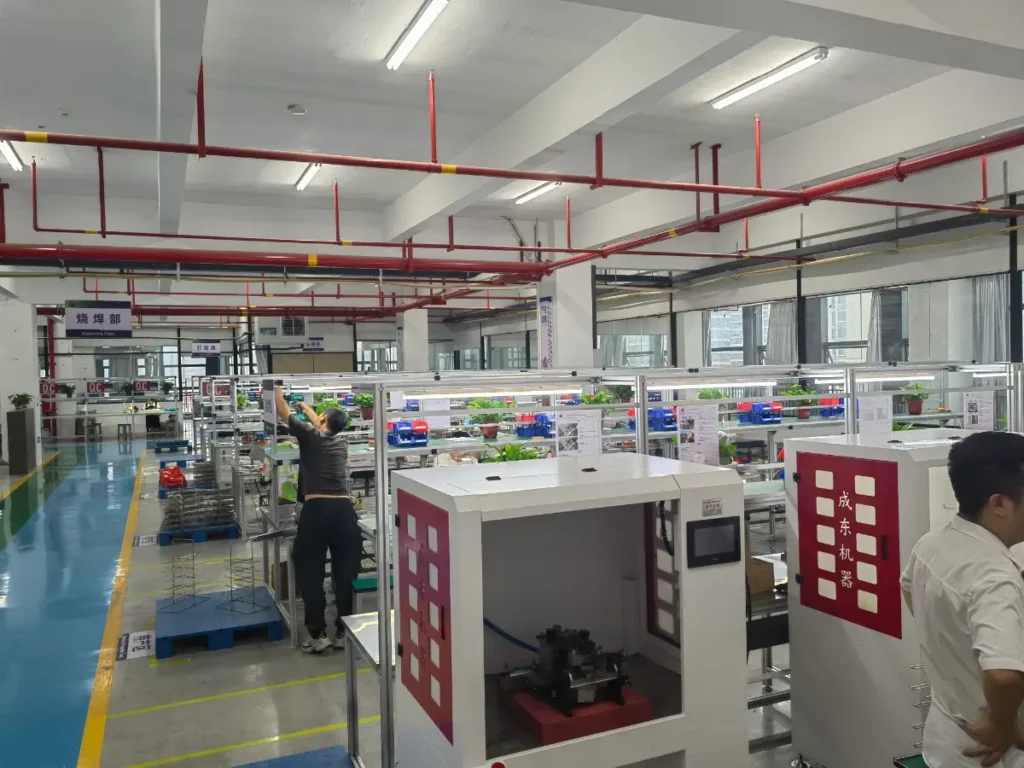
- “Request a video factory tour. We do these regularly. You’ll see the CNC machines, the tumbling barrels, the QC instruments, and the final inspection station — not just a showroom.”
“Can you match the look of [premium brand]?”
Don’t say “yes, we have.” Instead:
- “That brand uses [specific material and process]. Here’s what’s happening in the market right now with that style — [trend insight]. We can produce a frame with the same material spec and finish quality. What’s your target retail price point and which market are you selling into? That determines whether you need Mazzucchelli acetate or if a high-quality alternative sheet gives you the same consumer experience at better margins.”
This approach — Trust First, Sale Second — is what separates advisors from order-takers. Buyers remember the supplier who educated them, not the one who said “yes, we have.”
7. The Cost Reality: What Premium Actually Costs
Understanding the factory-gate cost structure helps buyers set realistic expectations and identify factories that are cutting corners to hit an unrealistic price.
| Cost Component | Commodity Frame | Premium Frame | What Drives the Difference |
|---|---|---|---|
| Acetate sheet (Mazzucchelli vs generic) | $0.30–$0.50/pair | $1.50–$3.00/pair | Material origin, color development, minimum orders |
| Titanium (Grade 5 vs ungraded) | N/A | $2.00–$5.00/pair | Mill certificates, grade verification |
| Hinges (commodity vs OBE/KANGHUA) | $0.10–$0.20 | $0.40–$1.20 | Brand, spring mechanism, barrel count |
| Barrel tumbling time (4h vs 24h+) | $0.05 | $0.30–$0.60 | Electricity, media consumption, throughput loss |
| Hand polishing (0 vs 30 min/pair) | $0 | $0.50–$1.00 | Skilled labor time |
| QC inspection (sampling vs 100%) | $0.05 | $0.30–$0.50 | Inspection time, instrument amortization |
| Testing (skip vs per-batch) | $0 | $0.20–$0.50 | Lab fees per batch |
| Total factory gate cost | $1.50–$3.00 | $5.00–$15.00 |
When a factory quotes you $2.50 for a “premium” acetate frame, ask yourself: which of these cost components did they skip?
8. What Wenzhouframe Brings to Premium Production
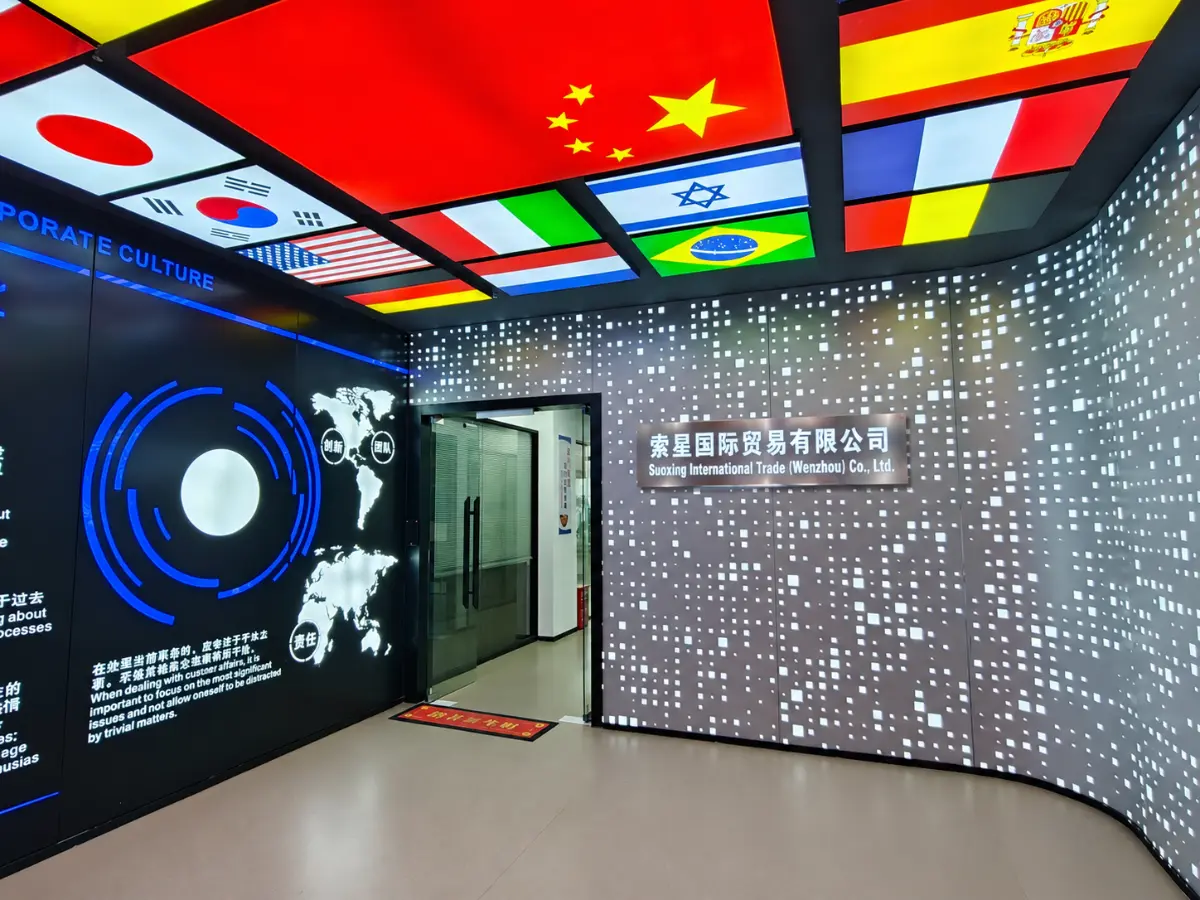
Based in Wenzhou’s Ouhai district — one of China’s two genuine premium eyewear manufacturing clusters alongside Shenzhen Henggang — our factory is equipped for mid-to-premium production:
- Materials: Mazzucchelli 1849 and Eastman Acetate Renew for eco-premium positioning; Grade 1 and Grade 5 titanium with mill certificates; lead-free nickel silver and stainless steel hardware
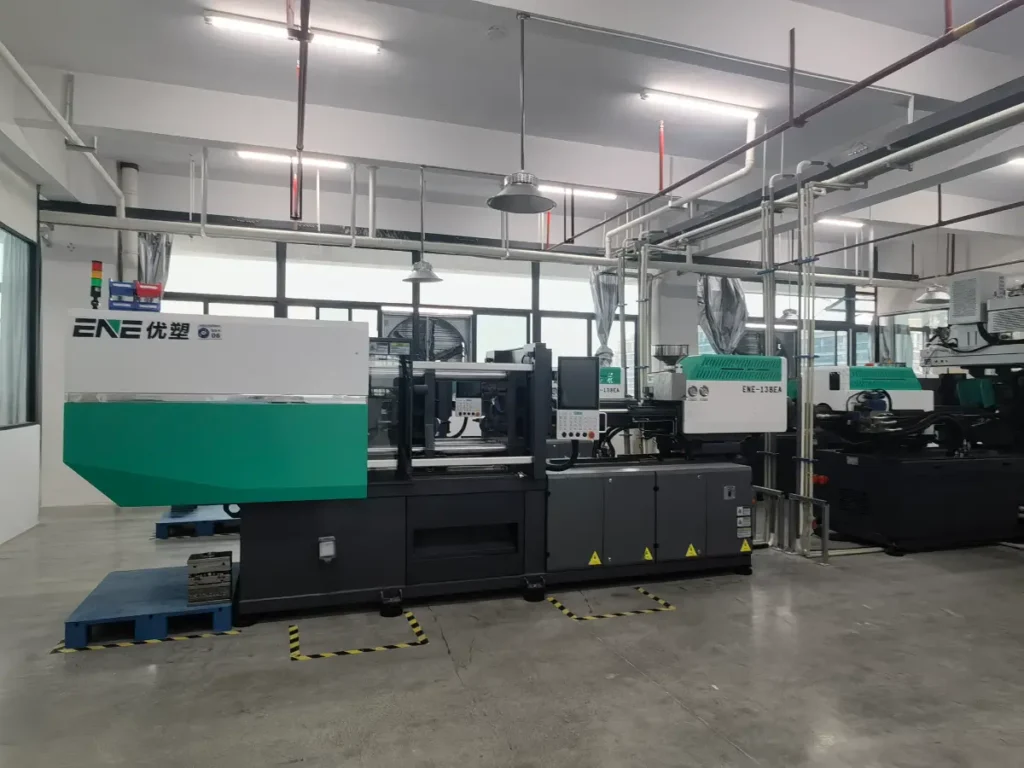
- Equipment: 4-axis CNC machines, precision wire shooters, controlled-temperature forming stations, multi-stage barrel tumbling line
- Finishing: Full hand-polishing capability with graded abrasive sequences; gloss meter verification on acetate frames
- QC: 100% final inspection on premium orders; AQL Critical 0 / Major 1.0 / Minor 2.5; gloss meter, roughness tester, torque tester, calibrated light box
- Compliance: ISO 9001 quality system; CE documentation; FDA registration support; per-batch nickel release, salt spray, and UV400 testing; third-party lab coordination (SGS, TÜV, Intertek)
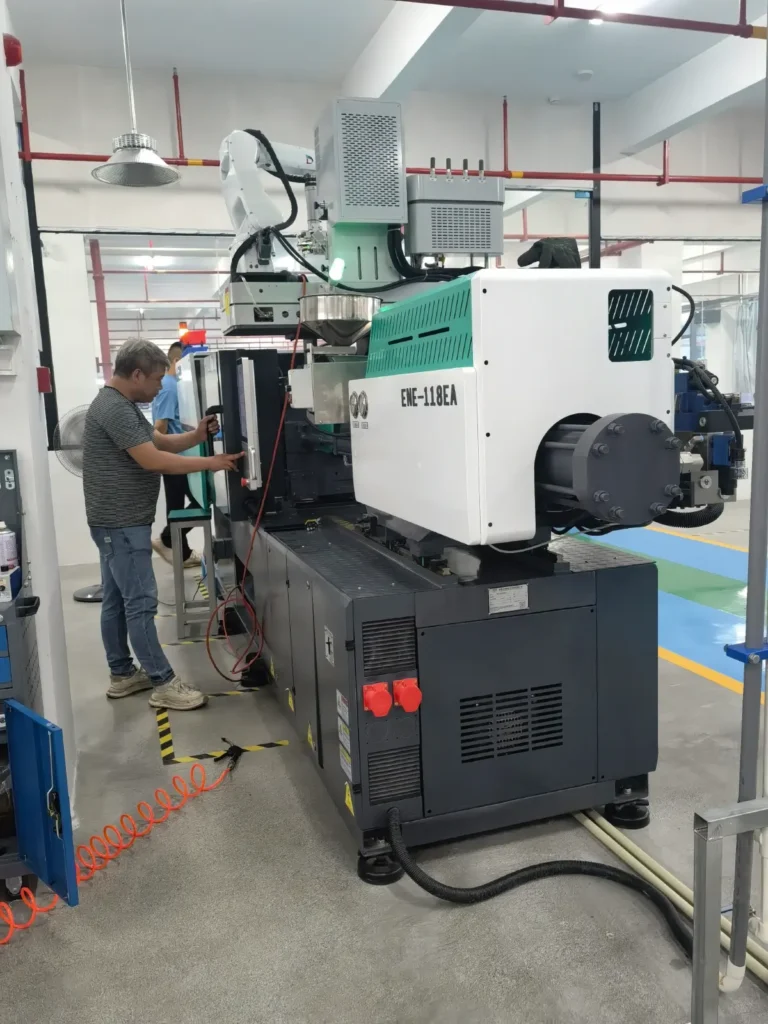
- Exclusive capability: Our TR90 dual-color injection molding process using 3 sequential molds produces frames with physical color layers that approach acetate’s visual depth — at TR90 weight and cost
We don’t position ourselves as a luxury atelier producing $2,000 frames. Our value proposition is specific: premium manufacturing quality at mid-range factory-gate pricing, from a genuine production district, with full compliance documentation.
If you’re sourcing frames that will retail from $80 to $400 — the accessible luxury to investment luxury tiers — that’s our sweet spot.
Ready to Discuss a Premium Collection?
We don’t send generic catalogs. Here’s how we work:
- Tell us your market and target retail price — this determines material, finish, and compliance requirements
- We recommend specific frame constructions with cost breakdowns showing what you’re getting at each price level
- Samples before commitment — produced to your exact specification, with sample fees refundable on production orders
- Full transparency — video factory tour, QC instrument verification, and third-party testing available on request
Email: mimi@wenzhouframe.com
WhatsApp: +86 152 5809 0639
Related Guides
- TR90 vs Acetate vs Metal: Complete Material Comparison
- Pure Titanium vs Beta Titanium: Buyer’s Guide
- Eyeglass Hinges: The Component That Determines Frame Lifespan
- Global Eyewear Manufacturing Regions: Where to Source
- How to Source Eyewear from China: Complete B2B Guide
- OEM vs ODM Eyewear: Which Manufacturing Model Fits You