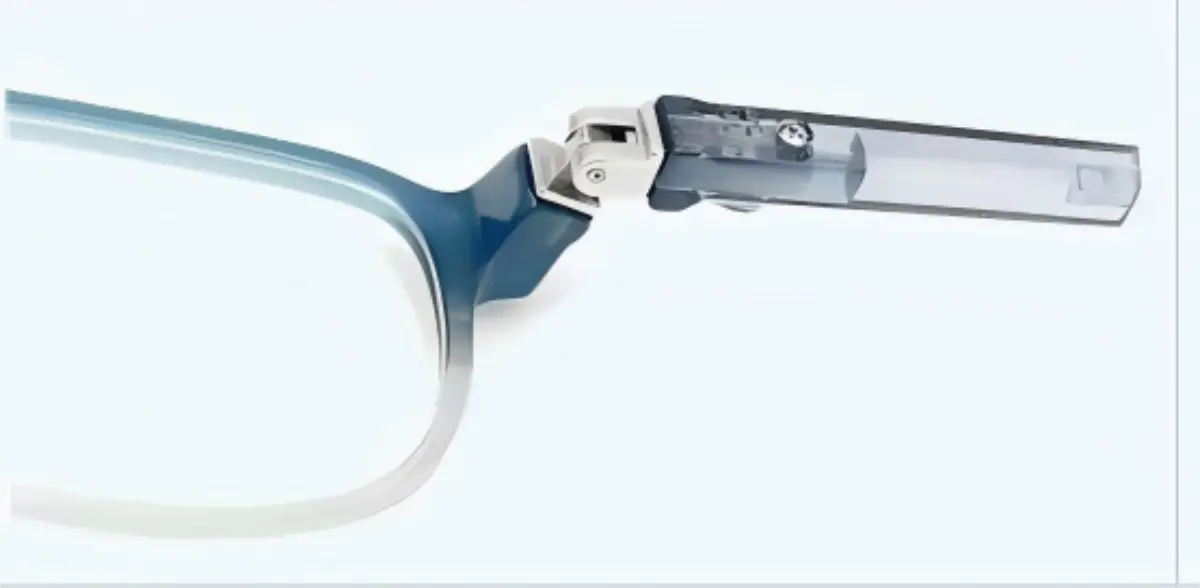
Most sourcing conversations focus on frame material, lens type, and overall design. The hinge gets treated as a commodity — a line item on a BOM that gets sourced from whoever quotes the lowest. That is a mistake. The hinge is the single most mechanically stressed component on any pair of glasses. It determines how the frame opens and closes over years of daily use, whether the temples hold their tension or go floppy after six months, and whether the joint corrodes when exposed to sweat and salt air.
This guide covers the eyeglass hinge supply chain as it actually exists in 2026 — who the major players are, what their products actually cost relative to each other, how hinge specifications work, and what separates a hinge that lasts from one that does not.
The Supply Chain in Four Tiers
The eyeglass hinge market has stratified into four clear tiers. Understanding which tier you are buying from — and whether that tier matches your product’s price point and quality expectations — is one of the more useful things you can do before placing a frame order.
Tier 1: International Premium (OBE, GLOBE)
OBE (Germany) and GLOBE (Italy) occupy the top of the global hinge market. These are the default choices for luxury eyewear brands — the names that appear on the component specification sheets for frames sold under Chanel, Dior, Tom Ford, and similar labels.
What you are paying for at this tier is not a secret mechanical advantage. The physics of a hinge do not change based on who manufactures it. What OBE and GLOBE deliver is consistency — extremely tight tolerance control across production runs, surface finishing quality that survives electroplating without pitting, and a brand name that carries weight in its own right. When a buyer asks your factory what hinges you use, saying “OBE” resolves the conversation. Saying “a domestic supplier” does not.
The price difference between OBE/GLOBE and the next tier down is substantial — typically 3x to 5x. For most mid-market brands and private label programs, this premium is difficult to justify on mechanical grounds alone. It is a branding and specification-sheet decision.
Tier 2: Domestic Mid-High End (KANGHUA)
KANGHUA (Kanghua Glasses Co., Ltd.) is the most significant Chinese hinge manufacturer at the mid-to-high end. Founded in 1978 and headquartered in Yuhuan, Zhejiang — the same province as Wenzhou — KANGHUA has spent nearly 50 years building technical depth in eyeglass hardware. They are a vice-chairman unit of the China Optometric and Optician Association, which is not a marketing title but a structural indicator of their position in the domestic industry.
From a sourcing perspective, KANGHUA’s relevant differentiator is their investment in process control. They run SAP ERP, MES manufacturing execution, and Siemens PLM systems — the kind of digital infrastructure that most Chinese hardware suppliers at their price point have not adopted. This matters because it translates directly into batch consistency. A hinge specification that calls for a 3.0mm spring box width will actually produce 3.0mm across 10,000 units, rather than drifting between 2.8mm and 3.2mm.
Their standard material for mid-to-high-end products is lead-free nickel silver (white copper), which meets RoHS and REACH requirements for the European market. Stainless steel is available for specific high-strength or high-corrosion-resistance applications. Screws are standardized in stainless steel across all product lines.
KANGHUA occupies a practical middle ground: significantly cheaper than OBE or GLOBE, with quality specifications that satisfy most international brand programs below the luxury tier.
Tier 3: High Value (Dayongfa, Kaida, Lida)
This tier is where most of the volume happens for Chinese domestic eyewear brands and export OEM production. Dayongfa, Kaida, and Lida are the names that come up repeatedly when you ask mid-range frame factories in Wenzhou and Shenzhen what hinges they run on standard production.
The value proposition is straightforward: lower price than KANGHUA, quality that is functionally adequate for the majority of consumer eyewear. These suppliers have been iterating on their tooling and processes for years, and the mechanical performance of their products is solid for normal use cases. The gaps compared to KANGHUA or OBE tend to show up in surface finishing consistency, plating adhesion over long-term wear, and the precision of spring tension calibration — not in catastrophic structural failure.
For private label programs, Amazon FBA brands, mid-range optical chains, and any product where the hinge brand name is not a selling point, this tier delivers the best cost-to-quality ratio in the market.
Tier 4: Cost-Optimized Volume (Taiheng, Huamei, Jingyi, White-Label)
The bottom tier serves the high-volume, price-sensitive segment: e-commerce promotions, pharmacy reading glasses, impulse-buy sunglasses, and any frame where the target retail price leaves very little room for component cost.
Taiheng Hardware specializes in common hinges and visible rivet hinges for acetate frames — the workhorse components of the Wenzhou and Taizhou production belts. Huamei Hardware is known for fast turnaround on injection-molded spring hinge structures for TR90 and mixed-material frames. Jingyi Hardware leans into inventory depth: wide specification range, stock availability, and low per-unit pricing driven by scale.
Beyond named brands, a significant volume of hinges at this tier comes from white-label factories in Guangdong and Zhejiang that run standard molds for common configurations — 3-barrel, 5-barrel, standard spring insert — and sell on price alone. These suppliers do not carry brand premiums, do not invest in marketing, and compete almost entirely on unit cost.
At this tier, the primary quality variable is electroplating thickness and corrosion resistance. Mechanically, most of these hinges will pass standard open-close cycle tests. Where they fall short is in long-term exposure to sweat, salt, and humidity — the conditions that cause copper bloom, coating delamination, and the kind of visible degradation that generates customer complaints and returns.
Hinge Specifications: What the Numbers Mean
Understanding hinge specifications is not optional for anyone making sourcing decisions. The following covers the major categories and their standard measurements.
Spring Hinge Insert Cores
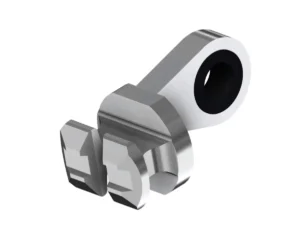
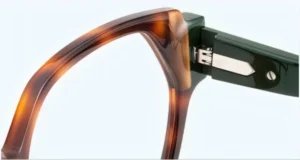
Spring hinges are the dominant choice for modern eyewear because they allow the temple to flex outward slightly, reducing stress on the frame and improving fit on a wider range of head sizes. The insert core — the metal mechanism that sits inside the temple end — is specified primarily by its box width.
Standard box widths: 2.6mm, 2.8mm, 3.0mm, 3.5mm, 3.8mm, 4.2mm, 4.4mm.
The functional difference between these sizes is straightforward: wider boxes accommodate stronger springs and are typically used on larger or heavier frames where more tension is needed to hold the temples against the head. Smaller boxes are for lightweight frames, children’s eyewear, and thin-metal constructions.
Spring hinge sub-types include:
- Common series: Standard spring mechanism for general use in metal, plastic, or mixed-material frames.
- Anti-rocking series: Adds structural reinforcement to reduce lateral play in the temple hinge. Useful on wider frames where temple weight can cause the hinge to develop wobble over time.
- Changeable mechanism: The internal spring core can be replaced without discarding the entire hinge. Relevant for brands that offer repair services or want to position around durability and serviceability.
- Injection spring mechanism: Specifically designed for frames where the hinge mechanism is overmolded with plastic during injection molding — standard in TR90 and some acetate frame production.
Regular (Non-Spring) Hinge Cores
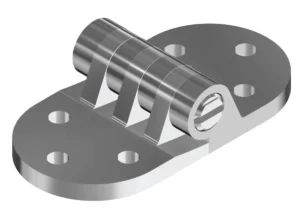
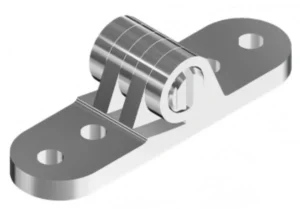
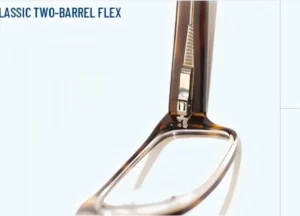
Non-spring hinges use a simpler barrel construction. They are specified by the number of barrels (interlocking loops that form the joint) and the total width of the hinge assembly.
Common configurations:
- 3-barrel (2+1): The minimum for functional eyewear. Used on low-cost frames and reading glasses.
- 5-barrel (3+2): The standard for most quality optical frames. Provides good structural rigidity and a solid open-close feel.
- 7-barrel (4+3): Used on premium acetate frames, particularly chunky and retro designs. The additional barrels distribute stress across a wider area, which matters on heavier frames. Also produces a distinctive, substantial open-close feel that consumers associate with quality.
Width range: 2.5mm to 8.0mm across all configurations.
Other Hinge Types
- Regular hinge for metal frames: Standard non-spring hinge designed for solder attachment to metal frames. Width: 2.2mm to 4.0mm.
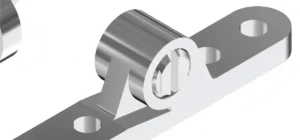
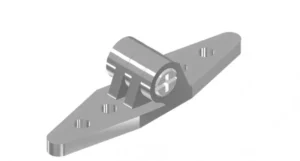
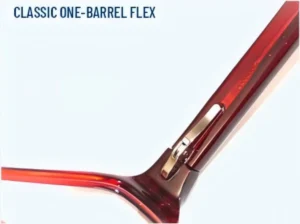
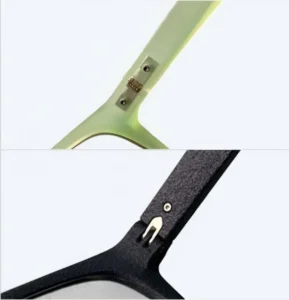
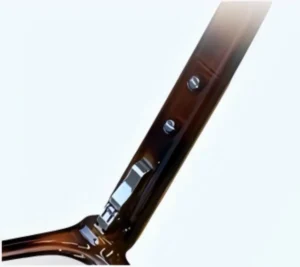
- Riveting hinge (visible hinge): The hinge is secured by rivets driven through the frame material, making the hinge barrels visible from the exterior. Standard on classic acetate frames and a defining design element of many retro styles. Width: 1.2mm to 8.5mm.
- Injection hinge: Designed for direct integration into injection-molded plastic frames. Includes safety hinge variants that prevent the temple from folding too far and damaging the frame.
Related Hardware
A complete hinge system requires more than just the hinge mechanism:
- Lugs (endpieces): The metal component connecting the frame front to the hinge. Width: 0.9mm to 10.0mm, depending on frame design and hinge type.
- Rim locks: Used on metal frames to secure lenses. Standard specifications include 2.0W, 2.4W, 2.5H, 2.6A, 3.0D, and 3.6W designations.
- Temple tips and arms: Some suppliers (KANGHUA included) supply semi-finished metal temples with hinge heads or insert cores pre-attached.
Material and Compliance: The Non-Negotiable
This section is short because the point is simple: if you are selling eyewear into Europe or North America, your hinges must be lead-free. Not “mostly lead-free” or “low lead” — lead-free.
EU REACH regulation restricts the presence of lead in articles intended for direct and prolonged contact with human skin. Eyeglass hinges fall squarely into this category. The consequence of failing compliance testing is not a warning letter — it is a product recall, a fine, and potentially a market access ban.
The standard material for compliant hinges is lead-free nickel silver (also called nickel silver or white copper). Stainless steel is the alternative for applications requiring higher strength or corrosion resistance. Both materials are widely available from every tier of supplier listed above. The risk is not material availability — it is suppliers who cut costs by using standard (lead-containing) nickel silver and hoping the buyer does not test for it.
If you are working with a new hinge supplier, especially at Tier 3 or Tier 4, require material certificates and consider commissioning independent RoHS/REACH testing on sample batches before committing to production volume.
Where the Real Quality Gap Lives
Most buyers assume the quality difference between hinge tiers is in the mechanical structure. It usually is not. A 5-barrel hinge from a Tier 4 supplier and a 5-barrel hinge from OBE use fundamentally similar barrel-and-pin mechanics. The spring mechanism inside a KANGHUA insert and a Dayongfa insert operates on the same principle.
The real gaps are in electroplating and surface treatment:
- Plating thickness: Premium suppliers apply thicker electroplated layers — more nickel undercoat, more chrome or PVD topcoat. This directly affects how long the hinge resists corrosion from sweat, salt water, and atmospheric moisture.
- Plating adhesion: Cheap plating looks acceptable when the frames leave the factory. It starts to fail after weeks of wear — tiny pits, flaking at stress points, discoloration at the temple joints. Premium plating stays intact because the surface preparation and plating process are better controlled.
- Spring tension calibration: On spring hinges, the opening force needs to fall within a specific range — enough to hold the temples against the head, not so much that the hinges are difficult to fold or put excessive stress on the frame. Higher-tier suppliers test and calibrate this. Lower-tier suppliers often do not, resulting in springs that feel either too loose or too stiff.
For practical purposes: if you are sourcing hinges at Tier 3 or below, specify that the supplier must pass a basic salt spray test (typically 24-48 hours per ASTM B117 or equivalent) and a sweat corrosion test. Most reputable suppliers at these tiers can meet this standard if you ask. The ones who cannot or will not are the ones to avoid.
Matching Hinge Tier to Product Tier
| Product Type | Recommended Hinge Tier | Rationale |
|---|---|---|
| Luxury/premium fashion frames (retail $150+) | Tier 1 (OBE / GLOBE) or Tier 2 (KANGHUA) | Buyers at this price point expect named component brands and visible specification quality |
| Mid-range optical frames and private label (retail $40-150) | Tier 2 (KANGHUA) or Tier 3 (Dayongfa / Kaida / Lida) | Best balance of quality, consistency, and cost. KANGHUA for brand-conscious programs, Tier 3 for cost-optimized programs |
| Reading glasses, pharmacy/retail, entry-level optical | Tier 3 or Tier 4 | Cost matters more than specification prestige. Ensure lead-free compliance and basic salt spray testing |
| Volume sunglasses, e-commerce promotions, impulse buy | Tier 4 (Taiheng / Huamei / white-label) | Lowest viable cost. Quality floor is adequate for the product’s expected lifespan and price point |
| Children’s eyewear | Tier 2 or Tier 3 with safety hinge | Safety hinge mechanisms prevent over-folding. Material compliance is non-negotiable for children’s products |
| Sport/performance eyewear | Tier 2 or Tier 3, stainless steel | Corrosion resistance requirements are higher due to sweat exposure. Spring tension calibration matters more |

What This Means for Your Sourcing Decisions
The hinge is a small component in terms of unit cost but a large component in terms of product perception and warranty risk. A frame that develops loose temples within months generates returns, negative reviews, and brand damage that costs far more than the savings from using a cheaper hinge.
The practical approach:
- Match hinge tier to product tier. Do not put Tier 4 hinges on a frame that retails for $100.
- Verify material compliance regardless of tier. Lead-free is not optional for export markets.
- Specify and verify electroplating quality, not just mechanical dimensions.
- For any supplier relationship, start with a sample batch and test it before committing to production volume.
At Wenzhouframe, we work with hinge suppliers across Tiers 2 through 4 depending on the product specification and target price point. We can advise on hinge selection for your specific program and ensure that the chosen component meets the compliance and quality standards your market requires. If you are evaluating hinge specifications for an upcoming order, contact us at mimi@wenzhouframe.com or WhatsApp +86 152 5809 0639 — we can walk through the options with actual samples and test data.

6.17_11.webp)