

Frame material trends move slower than fashion trends, but when they shift, they shift the entire economics of a product category. Understanding what’s gaining ground in 2026 helps you make better sourcing decisions at the expo and in the months that follow.
Here is an honest assessment of five materials that are seeing meaningful movement this year.
ULTEM (PEI): The Material Premium Brands Are Starting to Specify
ULTEM — the trade name for polyetherimide (PEI) — has been a niche material in eyewear for several years, but 2026 is the year it’s moving from niche to serious consideration for brands that want to differentiate on weight.
The basic case for ULTEM is straightforward: it’s lighter than acetate, lighter than standard metals, and significantly lighter than titanium while maintaining enough rigidity for a quality optical frame. A complete ULTEM frame can run under 10 grams. For comparison, a standard acetate optical frame is typically 18 to 24 grams.
What’s changed in 2026 is that the material has become more accessible from a manufacturing standpoint. Tooling and processing costs have come down as more factories have developed the capability, which means the premium over standard materials is narrowing. For brands targeting the premium optical market — particularly in Europe and North America where weight is a primary purchase driver — ULTEM is worth evaluating seriously.
The main limitation: color options are narrower than acetate, and the aesthetic is more functional than fashion-forward. ULTEM frames work best for optical buyers with professional or technical customer profiles rather than fashion-driven ones.
We produce ULTEM frames and have current styles available in the sample room. If ULTEM is on your radar, this is worth seeing in person.
Beta-Titanium: Not New, But Commanding More of the Premium Market
Beta-titanium has been around for decades. What’s shifted in 2026 is the market expectation: premium optical brands are increasingly treating beta-titanium as the minimum specification for a high-end frame, rather than a premium upgrade from stainless steel.
The reason is the combination of weight and flexibility. Pure titanium is lighter, but beta-titanium allows for thinner, more spring-loaded temples that hold adjustment better over time. For the optical channel — where customers wear frames for two to three years and expect them to hold their fit — this is a genuine functional advantage.
For buyers sourcing frames for premium optical retailers, the question to ask is not “can you do titanium?” but “which titanium alloy, and what are the mechanical properties?” Factories with genuine titanium capability can answer this in detail. Those with superficial capability will give you vague assurances.
Our titanium production covers both pure titanium and beta-titanium with in-house fabrication. We can walk you through the specific properties of each and show you comparison samples during your factory visit.
ISCC-Certified Eco-Acetate: Moving from Marketing to Requirement
Three years ago, “eco-friendly acetate” was primarily a marketing position. Today, it’s becoming a procurement requirement for buyers supplying major European retailers.
The shift is driven by EU regulatory pressure on sustainability claims and by retail chains implementing their own supplier sustainability standards. Buyers who want placement with certain European optical chains and fashion retailers now need documentation that their acetate meets a recognized sustainability standard — not just a manufacturer’s claim.
ISCC (International Sustainability and Carbon Certification) is the most recognized standard in this space. Eastman Acetate Renew, which carries ISCC certification, is the material we use for our eco-acetate line. The biodegradable S70 option is a further development for buyers who want a fully biodegradable claim.
The visual quality of ISCC-certified acetate is comparable to standard acetate. The color depth and surface finish are essentially indistinguishable to an end customer. The difference is entirely in the documentation you can provide your retail partners and the claims you can make on your packaging.
If you’re selling into the EU or working with sustainability-focused retail buyers, this is worth understanding before you place your next acetate order. We can show you the certification documentation and the material itself during your factory visit.
TR90: The Volume Story of 2026
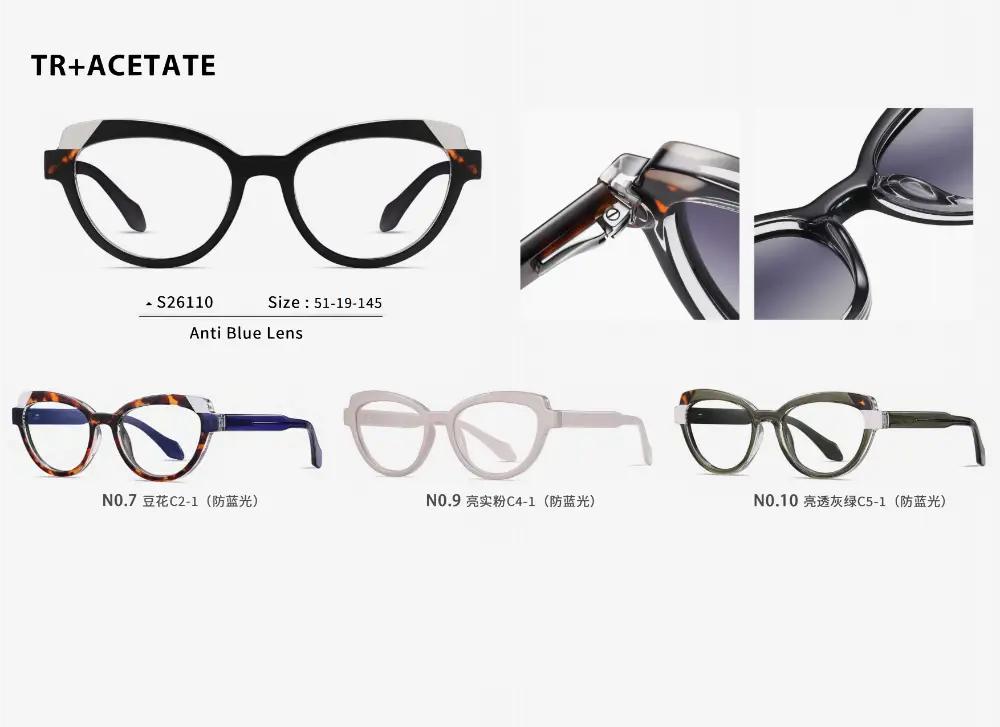
TR90 isn’t new — it’s been a significant material for about fifteen years. But in 2026, it’s capturing a larger share of the volume optical market for a specific reason: the price pressure on mid-market frames is creating strong demand for a material that delivers lightweight performance at a price point that supports aggressive retail pricing.
TR90’s key properties — lightweight (typically 12 to 16 grams for a complete frame), flexibility (bends significantly without breaking), and impact resistance — are well established. What’s changed is the range of styles available. Early TR90 frames were primarily sport and wraparound designs. The current TR90 catalog includes credible fashion-optical styles: round shapes, rectangular profiles, and variations on cat-eye that look substantially similar to acetate styles at significantly lower cost.
For buyers targeting the mass-market optical channel, Amazon, pharmacy chains, and value-oriented DTC brands, TR90 is the material story worth paying attention to in 2026. The quality floor has risen while prices have stayed competitive.
Aluminum-Magnesium Alloy: The Answer to “Metallic But Not Heavy”
The aluminum-magnesium alloy category has gained ground in sunglasses specifically, where it fills a gap between fashion acetate and performance TR90. It delivers the visual language of metal — which certain customer profiles associate with premium quality — at a weight that’s comparable to TR90.
Al-Mg alloy frames typically run 14 to 18 grams for a complete sunglass frame, compared to 18 to 28 grams for a comparable metal or acetate construction. The material takes surface finishes well — brushed, anodized, matte — which gives designers significant flexibility.
For buyers building sunglass lines for the outdoor, sport, and casual premium segments, Al-Mg alloy is worth adding to your material evaluation. The price point sits above TR90 but below premium acetate, which gives it a useful position in a range that covers multiple customer segments.
See All Five Materials in Person
Material descriptions, like product photography, only convey so much. The weight difference between ULTEM and acetate is striking when you hold both frames simultaneously. The spring quality of beta-titanium versus standard stainless is immediately apparent when you flex the temple. These are things you can evaluate in our sample room during a factory visit.
We’re available for visits throughout expo week: May 8, 9, and 10. If material evaluation is your primary goal for the visit, let us know when you book — we’ll organize the sample room to make the comparison as useful as possible.
- WhatsApp: +86 152 5809 0639 (Mimi)
- Email: mimi@wenzhouframe.com
Wenzhouframe — Established 2015. Material capabilities: pure titanium, beta-titanium, handcrafted acetate (ISCC-certified eco option), TR90, ULTEM, aluminum-magnesium alloy, stainless steel, monel. Wenzhou, China.

6.17_11.webp)